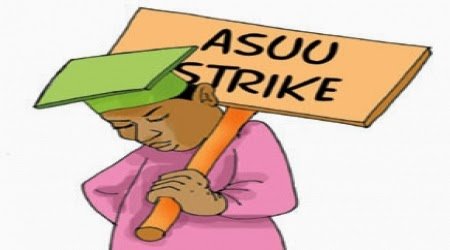
UPDATED: ASUU Extends Six-Month-Old Strike Indefinitely
The Academic Staff Union of Universities (ASUU) on Monday extended its six-month-old strike indefinitely until the Federal Government meets its demands.
A member of the union, who pleaded anonymity, confirmed the development to Channels Television following a National Executive Council (NEC) meeting of the striking varsity teachers at the University of Abuja.
He said the union extended the industrial action after reviewing progress reports on ongoing negotiations with the Federal Government in the last four weeks when ASUU rolled over the strike.


Last week, the Minister of Education Adamu Adamu said the Federal Government had addressed most of the union’s demands including the release of N50b for the payment of earned allowances for academic and non-academic and non-academic staff of universities.
ASUU embarked on the strike on February 14th, 2022. It had then declared a four-week warning strike. But after a month, the lecturers extended it by eight weeks, saying the government needs more time to look at its demands.
Following the Federal Government and lecturers’ inability to reach a resolution, the union on May 9 further extended the strike by 12 weeks.
The university teachers are seeking improved welfare, the revitalisation of public universities, and academic autonomy among others. Several meetings between government representatives and ASUU have ended in deadlock. One such was held about two weeks ago with the Professor Nimi Briggs Committee at the National University Commission (NUC) in Abuja.
But a senior member of ASUU told Channels Television that the Briggs Renegotiation Committee did not come up with a new deal. The anonymous source said the committee had pleaded with the union to suspend the strike and promised that their concerns will be included in next year’s budget.
Since the industrial dispute, several groups and individuals have waded into the matter. The latest is human rights lawyer Femi Falana who asked the Federal Government to sign the renegotiated agreement with the striking workers.
“Instead of engaging in the diversionary tactics of blackmailing ASUU the Federal Government should ensure that the strike is called off by signing the Renegotiated Agreement with ASUU without any further delay,” Falana said in a statement he issued on Sunday.
“While calling on both sides to resume the negotiations in the interest of the country the Federal Government should be prevailed upon to end the prolonged industrial action.”
Related Article: ASUU divided over strike suspension, holds NEC meeting
Contents
FAQs on the topic “UPDATED: ASUU Extends Six-Month-Old Strike Indefinitely”:
Why did ASUU extend the six-month-old strike indefinitely?
The Academic Staff Union of Universities (ASUU) extended the strike indefinitely due to the Federal Government’s failure to fully meet its demands. These include issues like funding for universities, payment of allowances, and implementation of previous agreements.
When did the strike originally begin?
The strike started on February 14, 2022, initially as a warning strike. However, it was repeatedly extended—from 4 weeks to 8 weeks, then 12 weeks—before reaching six months and eventually becoming indefinite.
What led to the decision to make the strike indefinite?
The decision was taken during a National Executive Council (NEC) meeting after reviewing the lack of progress in negotiations with the Federal Government. ASUU concluded that there was no meaningful commitment to resolving the dispute.
What are the major issues ASUU is demanding?
ASUU’s key demands include:
-
Revitalisation and proper funding of public universities
-
Payment of earned academic allowances
-
Implementation of the 2009 ASUU-FG agreement
-
Academic autonomy for universities
-
Adoption of a preferred payment platform (UTAS)
Failure to address these issues has been the main cause of the prolonged strike.
What impact did the indefinite strike have on students and universities?
The indefinite strike led to prolonged closure of public universities across Nigeria, disrupting academic calendars and causing students to lose valuable time. It also contributed to uncertainty in the education sector and affected academic progress nationwide.